


Summer programs are a perfect opportunity to give students meaningful hands-on STEM experiences. We have a full round-up of enrichment curriculum for district summer programs, and new units for anyone planning a one-off multi-age STEM event.
But how do YES units work for a one-week STEM camp? Themed day camps are popular with parents because they keep kids learning and break up summer boredom. If you've ever planned your own STEM camp, you already know that the key is having a solid plan for each day well in advance so you can gather materials and plan.
We’ve got you covered.
Below you will find example maps for five-day STEM camps for four different age groups, all using YES engineering enrichment activities that kids will love and remember for years to come. You can save time by purchasing complete materials kits, or simply download the units linked in the chart. Ready? Let's plan your STEM Summer camp!
A basic daily schedule for all ages
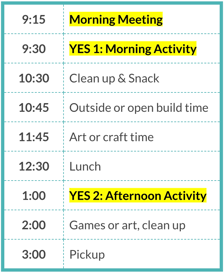
First, here's a flexible outline you can use as a starting point for a day at STEM camp. Highlighted activities are outlined in the age-specific schedules below. This is just a starting point, and you may want to adapt it depending on your goals.
For example, middle school students may want to spend more time on their engineering projects or work on researching other problems they can solve together, so you might want to extend those activities to 90 minutes and remove some of the open build time.
Early learners (Grades PreK-K)
Noisemakers, Bubbles, and More
Your young campers will learn about engineering with puppetry, stories, singing, and playful problem solving. The simplified Engineering Design Process builds confidence and ownership, while the stories and songs help it stick.
| PreK - K | Day 1 | Day 2 | Day 3 | Day 4 | Day 5 |
Morning Meeting |
Introduce a puppet friend. What is an engineer? |
Today we're going to make some noise and make things move. |
Today we're going to knock something down, and make something float. |
Today we are going to learn all about bubbles. |
Today we're going to plan, build, and test. |
| YES 1 (Morning Activity) |
Wee Engineer Prep Activity 1 |
Wee Engineer Challenge: |
Wee Engineer Challenge: |
Bubble Wands Activity 2: |
Bubble Wands |
| YES 2 (Afternoon Activity) |
Wee Engineer Prep Activity 2 |
Wee Engineer Challenge: |
Wee Engineer Challenge: |
Bubble Wands |
Bubble Wands Activity 5: |
Need more activities? In the folders for Wee Engineer and Bubble Wands, you'll find supplemental ideas, reading lists, and "family activities" which you can add throughout each day.
Lower Elementary (Grades 1-2)
Bandages and Sails
Lower Elementary students are ready for a slightly more sophisticated design process, while still having fun! For this age group, we picked two of our favorites Enrichment units, Bandages (have you ever met a young child who didn't LOVE talking about their minor injuries?) and Sails.
| Lower Elementary | Day 1 | Day 2 | Day 3 | Day 4 | Day 5 |
| Morning Meeting |
Today's focus: What is an engineer? What is technology? |
Today's focus: Why do engineers always make a plan before |
Today's focus: |
Today's focus: |
Today's focus: |
| Morning YES Activity |
Bandages Activity 1 Engineering Design Process Educator guide p 33 |
Bandages Activity 3 Exploring Materials Educator guide p 47 |
Bandages Activity 5 Create, Test, Improve Educator guide p 67 |
Sails Activity 2 What's the Problem? Educator guide p 37 |
Sails Activity 4 Imagine and Plan a Sail Educator guide p 55 |
| Afternoon YES Activity |
Bandages Activity 2 What's the Problem? Educator guide p 39 |
Bandages Activity 4 Imagine and Plan Educator guide p 57 |
Bandages Activity A and B Decorate, design one for a finger Educator guide p 77 |
Sails Activity 3 Explore Sail Materials Educator guide p 45 |
Sails Activity 5 Create, Test, Improve Educator guide p 61 |
Bonus ideas! In the folders for Bandages and Sails, you'll find supplemental activities and reading lists in the Family Letter for each. Sprinkle these activities through the week, or invite kids to take them home to try with their parents or caregivers.
Upper Elementary (Grades 3-5)
Rescue Shuttles & Rescue STEM Careers
Upper elementary students love launching mini rockets in this weeklong STEM camp is focused on aeronautical engineering, rescue operations, and more.
| Upper Elementary | Day 1 | Day 2 | Day 3 | Day 4 | Day 5 |
| Morning Meeting |
What is an Engineer? How does Engineering work? |
Why do Engineers always plan before they start building? |
Talk about testing, failure, and improving |
Today we will work on solving other problems related to our rescue |
Reflect on a week of engineering |
| Morning YES Activity |
Rescue Shuttles Activity 1 The Engineering Design Process Educator guide p 33 |
Rescue Shuttles Activity 3 Explore Weights and Fins Educator guide p 49 |
Rescue Shuttles Activity 5 Test and Improve Educator guide p 63 |
Rescue Shuttles Activity A "Waterproof bag" Educator guide p 69 |
Rescue Shuttles: Disaster Recovery Careers (Full activity) |
| Afternoon YES Activity |
Rescue Shuttles |
Rescue Shuttles |
Rescue Shuttles |
Rescue Shuttles |
Rescue Shuttles |
For more ideas to include throughout the week, review the activities suggested in the family letter for Rescue Shuttles. Some camp leaders also invite special guests such as first responders, pilots, engineers, or other community members to come and share details about their jobs.
Middle School (Grades 6-8)
Biotech camp: Prosthetics for Injured Animals and Engineering Antivirals
Kids in this age group start thinking of ways to have an impact on their community. Over five days, students will experience life as a bioengineer, while learning about surprising STEM careers related to health care.
| Middle School | Day 1 | Day 2 | Day 3 | Day 4 | Day 5 |
| Morning Meeting |
Introduce Engineering Design Process |
Brainstorm: compare science and engineering |
What are ways you have used engineering in everyday life? |
Talk about testing, failure, and improving. |
Career Connections for each unit |
| Morning YES Activity |
Animal Prosthetics Activity 1 A Leg to Stand On (Design a leg for an elephant) Educator guide p 17 |
Animal Prosthetics Activity 3 Prosthetic tails (Create a tail for an injured fish) Educator guide p 27 |
Antivirals Activity 2 The Problem with Viruses Educator guide p 39 |
Antivirals Activity 4 Create, Test, Improve Educator guide p 55 |
Antivirals Career Connections |
| Afternoon YES Activity |
Animal Prosthetics |
Animal Prosthetics |
Antivirals |
Antivirals |
Antivirals Activity A Build a Quarantine Box Educator guide p 67 |
Make it your own
Of course, these are just a few ways to structure a week of STEM learning.
You might be planning a full engineering camp, or just looking to weave a few meaningful STEM activities into a traditional summer program. You may stretch these lessons across several weeks, shorten them for half-day sessions, or mix and match based on your students’ interests. YES Educators have done it all, and we are always amazed by the creativity and flexibility of teachers and enrichment planners.
However you design your program, you'll be giving campers a positive experience with engineering as they work together to solve real problems.
To get started, browse our full collection of summer-ready enrichment, get free digital access to lessons, or reach out to learn more about complete kits and implementation support.


