


As educators, we know that students thrive when families get involved and help reinforce learning. Research suggests that this is especially true for STEM. While positive STEM experiences in school have a significant influence, discussions at home amplify that impact by shaping a child’s interest and identity. One study found that childhood conversations about science at home are one of the few early experiences that significantly predict whether a student will later identify as a “STEM person” in college (Dou, 2019).
Even so, many parents hesitate to talk about topics like science and engineering with their kids. Even when family members agree that STEM learning is very important, a few common barriers get in the way:
- Lack of technical knowledge
- Worry about cost
- Uncertainty about what hands-on STEM actually looks like
How do we help caregivers feel more confident talking about science, technology, engineering, and mathematics in everyday life?
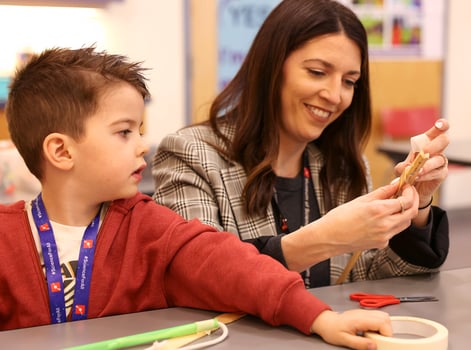
Young learners and families engineer solutions during a community STEM event
“I’m just not a STEM person.”
This is probably the biggest barrier to getting families involved. Many caregivers hesitate to try or talk about STEM activities because they don’t have a technical background themselves.
The first step is helping them see that it’s not about expertise. Their involvement strengthens their child’s education, regardless of technical knowledge. Conversations connect a child’s in-school experiences to their lives, culture, and traditions beyond the classroom. The connection alone helps children make sense of what they're learning and build deeper understanding (McClain, 2014).
And most parents use STEM more than they realize. Asking questions, solving problems, using tools, and adjusting plans based on new information are examples of everyday STEM thinking.
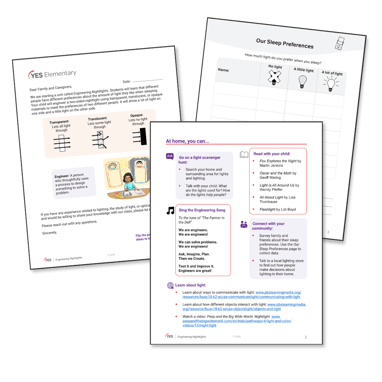 To support this involvement, we include a letter to families with every YES curriculum unit, offering background information, conversation prompts, simple activities, and reading lists that connect to what students are doing in class.
These letters, provided in English and Spanish, can be sent home in backpacks, shared via text messaging apps, or your school’s LMS. As caregivers learn more about engineering work happening at school, they become more of a partner in their child's STEM education. Adults may even discover that they are more of a STEM person than they realized.
“We can't afford fancy tech.” 
This is a common concern. While educators know that meaningful learning can happen with simple materials like tape, paper, and pompoms, many families associate STEM with robotics kits and top-of-the-line laptops.
We can help by emphasizing that STEM learning starts with simple moments like asking questions during a walk, thinking out loud while cooking dinner, or while fixing something around the house. No cost, and no devices needed.
“We never did engineering when I was in school.”
Sometimes the barrier is simply that caregivers can’t picture what hands-on STEM learning looks like in practice. Fun, low-pressure family STEM events help them see how it works firsthand. Families can observe, ask questions, and even participate in engineering challenges with their children.
 Family STEM events give families a chance to see hands-on engineering in action.
Because hands-on STEM activities give every student a chance to shine, parents may see their child in a new light. One educator shared, “families realize their kid can be a real engineer, even if mom and dad aren't!”
Just as importantly, these activities are designed to be welcoming for adults. Participants are guided through the Engineering Design Process, and the open-ended nature of the challenge removes pressure to find a single “right” answer. Event signage makes the process clear, and gives caregivers language they can begin to use in conversations at home (Perdew-Kenny, 2025).
PTA and PTO groups are often eager to support these kinds of community-building events. To learn more about one-off STEM event activities and how they work, see our earlier blog post Low-Prep, High-Impact STEM Activity Kits.
The bottom line: Communicate and invite families in
To recap, here are a few concrete things we can do to help parents and caregivers get more involved with STEM at home:
- Define Science, Technology, Engineering, and Mathematics as ways of thinking and solving problems, not as buckets of highly technical knowledge.
- Communicate what we mean by parent involvement. Send home letters offering specific wording, prompts, and activities they can try at home.
- Create opportunities for shared experiences that show them how it works.
By giving families the tools to talk about science and engineering, we can remove barriers and build a sense of belonging -- engineering is for everyone. Over time, interactions between home and school create a positive feedback loop that strengthens a child’s identity as a confident problem-solver.
Citations
Dou, R., Hazari, Z., Dabney, K., Sonnert, G., & Sadler, P. (2019). Early informal STEM experiences and STEM identity: The importance of talking science. Science Education, 103(3), 623–637. https://doi.org/10.1002/sce.21499
McClain, L., & Zimmerman, H. (2014). Prior Experiences Shaping Family Science Conversations at a Nature Center. Science Education, 98(6), 1009-1032. https://doi.org/10.1002/sce.21134
Perdew-Kenny, O., Wareham, J., Simpson, A., Penney, L., Anderson, A., & Maltese, A. (2025). Making the Engineering Design Process Visible: Effects of Interventions on Caregiver–Child Interactions. Journal of Museum Education, 1–8. https://doi.org/10.1080/10598650.2025.2468042


