

Companies and foundations invest millions of dollars in STEM education each year, delivering technology, curriculum, and other resources into schools. But getting resources through the school doors is only the first step. How can donors make sure their investments translate into meaningful learning for students—not just in the short term, but for years to come?
Education has long been a major focus of Dot Foods’ philanthropic work, starting with cofounder Dorothy Tracy, who was herself an educator. More recently, the company has focused on offering more STEM education opportunities for students. So when Dot Foods set out to deepen its support for STEM education close to home in West Central Illinois, the company wanted to make a lasting difference.
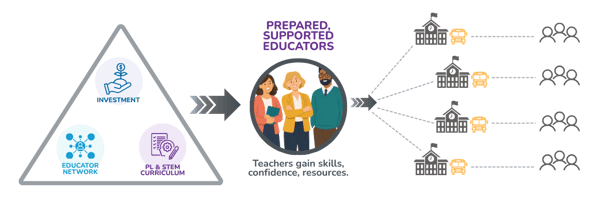
Rather than simply providing more equipment or curriculum, the Dot Foods Charitable team wanted to focus on the people who would ultimately turn those resources into student learning: teachers. This spring, 50 educators from districts in western Illinois were invited to the Dot Foods main campus for in-person professional learning workshops led by Youth Engineering Solutions (YES).
What made this program successful was a partnership among three organizations, each playing a critical role: Dot Charitable provided the funding and direction. The Learning Technology Center of Illinois (LTC) brought deep ties and relationships with local schools and districts, along with knowledge of what kinds of STEM PL educators in the region needed and wanted most, and YES provided hands-on professional learning, curriculum, and implementation support. Together, they created a path from philanthropic investment to classroom use.
Reaching educators across the region
To reach schools in the area, Dot Foods partnered with the Learning Technology Center (LTC). A program under the Illinois State Board of Education, LTC works directly with statewide public K-12 districts, schools, and educators, connecting them with technology, training, and other resources.
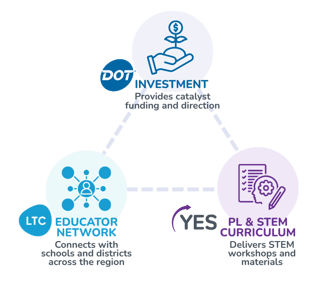 “We had the mission and the means of supporting STEM education locally, and LTC stepped in with the relationships and understanding of the educational system so that together we could provide educators with what they need,” says Suzy Parn, Director of Dot’s Charitable Program.
Lisa Schwartz, an Educational Technology Coordinator for LTC, was excited by Dot Charitable's focus on professional learning. “Access to good curriculum isn't always enough to get teachers using it,” Schwartz said, “You can’t just say Here’s free curriculum. They’ve got to be immersed in it.”
Through LTC’s relationships with schools in the region, Lisa knew she could find educators who would be eager to sign up for STEM-focused PL. The next question was what that professional learning would look like. When LTC began looking for a professional learning partner, Schwartz remembered a program she had used years earlier called YES (Youth Engineering Solutions, formerly EiE).
Part of the Museum of Science in Boston since 2003, YES offered curriculum that Schwartz already knew and trusted. More importantly, she knew that YES also offered professional learning workshops that would help educators experience STEM lessons as a student. “Teachers don't always have the time and opportunity to see the curriculum through their students' eyes. Thanks to Dot Charitable, teachers would have the dedicated time and opportunity to step into their students' shoes during hands-on, in-person training.”
The flexible, hands-on approach also made YES professional learning appealing. Rather than sitting through a presentation about engineering instruction, teachers worked on the same challenges using the same Engineering Design Process their students would learn to use. And like their students, they collaborated, asked questions, developed possible solutions, built and tested designs, used evidence, and improved their ideas.
.png?width=259&height=224&name=1%20Cover%20(1).png) Schwartz was excited to see how offering professional learning changed the whole dynamic of the project. “We knew teachers wouldn't just receive (information about) Museum of Science curriculum—they’d get to test the ideas firsthand, and experience the wonder of the lessons before bringing them to life in the classroom.”
Schwartz was excited to see how offering professional learning changed the whole dynamic of the project. “We knew teachers wouldn't just receive (information about) Museum of Science curriculum—they’d get to test the ideas firsthand, and experience the wonder of the lessons before bringing them to life in the classroom.”
Schwartz coordinated with the YES professional learning team to offer a two-day workshop in April 2026 to a cohort of 50 teachers from more than 30 districts. Scheduling around so many districts wasn’t easy, but Schwartz knew from past experience that holding the workshop before summer would give the educators time to attend, explore the curriculum, and consider how hands-on STEM could fit into their teaching before planning for the coming school year.
Putting teachers in the learner's seat
Kendall Brinson from the YES team flew to Illinois to lead the workshop. Despite severe storms in the area, she remembers educators arriving enthusiastic and ready to participate. On day one, teachers experienced elementary activities, including Engineering Pumpkin Pollinators. “It was the largest set of participants we’ve ever had doing the Pollinator game,” Brinson said, “Imagine dozens of adults running and buzzing around the room, some were bees, and some were flowers.”
The next day, educators tackled middle school challenges, including Engineering Landing Pads. “They were SO committed to making sure their designs were foolproof!” Brinson shared. She remembers one group was so invested in testing their design that the teachers found a way to drop their sand-filled balloons from 12 feet—four times the height the challenge required. The same curiosity and persistence they hoped to foster in their students had quickly taken hold among the educators themselves.
After two days packed with hands-on STEM and planning, fifty teachers left the workshop feeling energized and prepared with firsthand experience they could bring back to their classrooms. Madelyn Tynan from Beardstown CUSD 15 appreciated taking on the students’ perspective: “I loved experiencing the activities that the children would be going through so I could better explain and walk them through.”
Allizon Menz from Blessed Sacrament Catholic School agreed: "It was so helpful to try out lessons that can easily be taken right back and implemented in my classroom the next day."
There aren't many classroom
back-to-school activities that can reveal so much in such a short time.
Removing the next barrier
After the workshops, the Dot Charitable team realized they wanted to take their investment a step further. Feeling ready to teach engineering curriculum is one thing. Finding, purchasing, organizing, and preparing materials for a classroom full of students is another.
“We understood from the beginning that teachers are sometimes challenged in accessing the materials they need for the kinds of projects that will engage and teach their students,” Parn says. “We wanted to remove that barrier so that they could immediately use what they learned in their own classrooms.”
YES classroom and enrichment units are available free online, and teachers are given a list of materials so they can assemble their own kits. However, as with any hands-on STEM curriculum, sourcing and organizing those supplies takes time, and isn’t always cost-efficient. Teachers in online forums often comment that gathering materials is often one of their biggest hesitations about implementing hands-on STEM.
To streamline the materials-gathering step, Dot Foods provided participating schools with up to $3,000 to purchase YES classroom kits, making it easier for educators to move from planning to implementation. They had experienced the instructional approach themselves. They had time to think about how it fit into their teaching. And now they had access to the materials needed to get started.
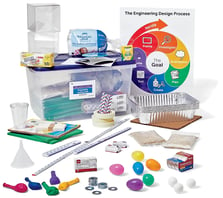 As kits began arriving this summer, teachers were already making plans for the school year. Dawn Lepper, a seventh-grade teacher from Payson CUSD #1 shared after receiving her kit: “I’ve been going through one of the units from the YES program, and it looks so good! I love how the kits have pretty much everything you need.”
By combining hands-on professional learning with time to plan and ready-to-use materials, the partnership helped teachers enter the school year prepared to put their learning into practice.
An investment that keeps multiplying
The 50 participating teachers are expected to reach more than 1,500 students during the 2026–27 school year. But unlike a one-time student program, an investment in teachers continues with them as new groups of students enter their classes each year. Teachers often return to the same units, becoming more familiar with the approach each time they teach them. YES research has found that educators continue to teach a YES unit for an average of five years—many will use a unit for more than a decade. Teachers who have been through hands-on workshops often go on to expand and adopt more engineering units to use through the school year.
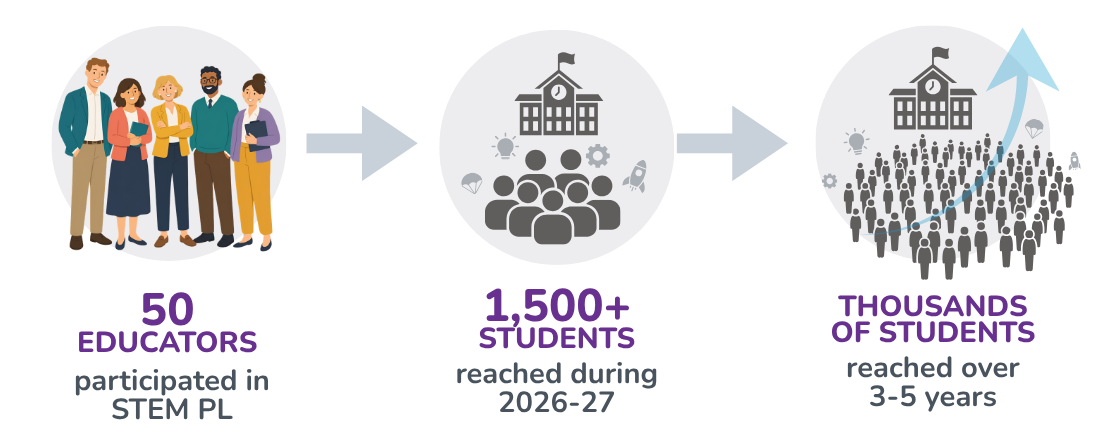
If these Illinois teachers follow a similar pattern, the impact of this spring’s professional learning and materials investment will extend to thousands more students over time.
A model worth repeating
The scale of the potential impact is exciting, but perhaps the most useful lesson is how each partner amplified what the others could accomplish. For companies and foundations looking to expand access to STEM education, this project demonstrates that meaningful impact doesn't require complex programs or expensive technology. It’s possible to reach students year after year by simply investing in teachers and giving them the support and resources to turn that investment into classroom learning. “There’s something really catalytic about bringing together organizations that know their local schools, funders that want to make meaningful investments in education, and partners that can provide high-quality instructional support,” says Christine Cunningham, Sr VP of STEM Learning at YES. “This school year, many students will experience hands-on engineering because of this single effort. And in the years ahead, the impact can keep growing thanks to the multiplying power of investing in teachers.”
Want to bring this model to your community?
We're looking for partners to replicate this approach elsewhere. That means:
- Funders ready to invest in teacher professional learning, not just equipment or curriculum
- Regional education organizations (like LTC) with the district relationships to organize a teacher cohort
- Districts with educators who want hands-on training and are willing to help recruit or host other teachers
If you see your organization in one of these roles, reach out to us at yes@mos.org to talk about what a partnership could look like.


