

Do you remember being a kid on the first day of a new school year? Wearing new clothes, carrying fresh spiral notebooks, finding your seat with a mix of excitement and worries. What are the rules? Will other kids talk to me? What if the work in this class is too hard? What is this year going to be like?
As teachers, we try to ease those worries. We introduce the rules and routines on the first day, but a classroom culture takes more time. Before we can really teach content, we first need to create a classroom where students feel safe asking questions, working together, and learning from mistakes.
Many educators like to start the year with hands-on STEM. A YES engineering challenge is a shared experience that helps set the tone and establish how this class will work together. As students learn the Engineering Design Process, they also learn expectations and classroom norms, begin to see themselves as capable problem solvers, and give teachers valuable insight into how their new students think and behave.
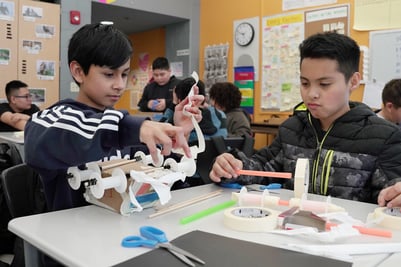
Early hands-on challenges reveal strengths that may have been hard to see otherwise
Help your students internalize norms
Even a short engineering warm-up introduces students to the Engineering Design Process while reinforcing important classroom habits:
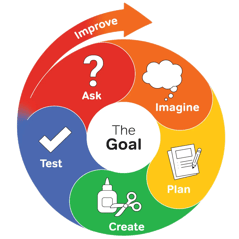 Ask. It’s okay to not know something yet. Questions are welcome.
 - Imagine. Different perspectives make stronger ideas. Everyone has something to contribute.
- Plan. It helps to think carefully and communicate your ideas clearly before you jump into action.
- Create. Challenges rarely go exactly as expected. Students learn that in this class, we adapt, collaborate, and work through frustration.
- Test. A design that doesn’t work isn’t a failure, it's evidence that helps us learn and move forward.
- Improve. We use evidence to make decisions and take the time to revise our work
Classroom expectations go from being words on the wall to habits students actually use.
Working together
All YES activities are team challenges. Throughout the process, collaborative behaviors arise as part of the way the challenge is structured: disagreements offer a chance to compare ideas and use evidence, and a team that changes direction sees that revising an idea is not the same as being wrong.
Seeing themselves as problem solvers
Going through the design process can broaden a student’s understanding of what it means to succeed in school. Traditional beginning-of-year or ice breaker activities often reward students who are already comfortable speaking in front of a group, writing about themselves, or navigating familiar academic tasks. Engineering offers many different ways to contribute.

One student notices that the group's design keeps tipping. Another organizes materials. Someone asks the question that changes the team's entire approach. A quiet student suggests testing two ideas instead of debating which one is best.
These moments showcase important skills, but even more importantly they show students that successful learning can look many different ways. They come to understand that you don't need to be the loudest voice or the fastest builder to contribute meaningfully. Over time, students build appreciation for each other's strengths, and begin to identify themselves in the classroom, not simply as someone who gets answers right or wrong, but as someone who can contribute, persist, and improve.
See each student in action
Hands-on design challenges also give teachers a remarkable opportunity to learn about their students. More than seeing what students know, a teacher can observe how they approach uncertainty, collaborate with others, and respond when things don't go according to plan.
There aren't many classroom
back-to-school activities that can reveal so much in such a short time.
In a single activity, we can observe students’ strengths and struggles:
- Collaboration. Who naturally invites others into the discussion? Who tends to take over?
- Approach. Who jumps right into building? Who likes to think before they act?
- Communication. Who explains ideas clearly? Who needs support putting things into words?
- Flexible thinking. Who changes course when presented with evidence? Who gets stuck and needs encouragement to reconsider an approach?
There aren’t many classroom back-to-school activities that can reveal so much in such a short time. Armed with these kinds of insights, a teacher is ready to make early decisions about grouping, discussion supports, classroom roles, and where individual students may need encouragement.
How to start the year with STEM
The Engineering Design Process is what ties these three outcomes together. As students work through the process during team challenges, it becomes more than a framework for solving problems. It becomes part of the classroom culture.
As students work through the
Engineering Design Process, it becomes
part of the classroom culture.
Start with a short engineering warm up
A full engineering unit doesn't need to happen during the first week of school. A brief engineering warm-up challenge is enough to introduce the Engineering Design Process while creating a shared experience the class can return to throughout the year.
Very early, teachers can begin reinforcing the classroom habits they want to see every day:
- “I noticed your team tested the idea instead of arguing about it.”
- “You changed your plan after you saw the evidence.”
- “You made space for everyone to contribute.”
- “Your first design did not work, but you used what you learned.”
Feedback in the moment helps students understand that success in this classroom is not about being perfect or having the best idea immediately. It is about contributing, learning, and improving.
Building on that foundation
Once classroom routines are established, you can introduce a longer engineering unit to give your class repeated opportunities to strengthen those habits. They will remember how it worked during the warm-up, as they practice more in-depth problems that call for greater collaboration, decision making, resilience, and thoughtful revision.
The learning and thinking habits that you introduced at the beginning become part of the classroom culture rather than isolated lessons. The Engineering Design Process becomes a familiar routine that teachers can refer back to throughout the year whenever students face a challenging problem or situation. A culture of thinking and problem-solving emerges naturally as students discover that mistakes are part of learning, every voice has value, and persistence matters.
Resources to help you get started
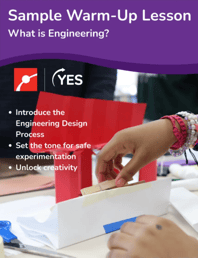 Whether you're trying engineering for the first time or looking for a new way to launch the school year, we've gathered resources to help.
On the YES back-to-school resource page, you'll find:
- a free downloadable engineering warm-up activity
- suggested units by grade level
- a funding guide with ideas for paying for materials kits
- registration for a free webinar about starting the school year with STEM


