

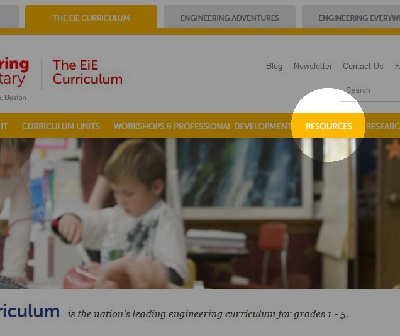
Your EiE Teacher Guide offers more than just lesson plans; it has teaching tips, assessment, and other useful extras. Did you know the EiE website is also packed with handy resources that help you teach elementary engineering? With our latest web redesign, these helpful teaching tools are more find-able than ever! Just click the “EiE Resources” tab and let us take you on a tour . . .
EiE Teaching Tips | Thursday, November 17
Resources for K-5 Engineering Are Just a Click Away!

Implementing EiE | Tuesday, November 15
A Lesson Comes to Life as Students Recreate EiE Storybook Scenario
EiE storybook characters are diverse by design. There are 20 different protagonists, all from different backgrounds, races, family situations, and abilities, and it’s for one good reason: students feel inspired when they read stories about someone they can identify with.
This intentional diversity was a plus for Claudine Conover, a PreK-5 science teacher at a small school in the Bronx, as she searched for STEM lessons that would resonate with her students.

Engineering Habits of Mind | Wednesday, November 9
Investigating Materials Properties is an Engineering Habit of Mind
We’ve told you about EiE’s
engineering habits of mind—positive strategies for problem solving that help define success not only in engineering but also across the curriculum. At EiE, we believe that a well-designed engineering curriculum can help students develop as many as 16 unique engineering habits of mind.
Investigating the properties and uses of materials is a habit of mind that is an essential foundation to engineering education—it allows students to make informed decisions as they plan, create, and improve their technologies.
Implementing EiE | Tuesday, August 27
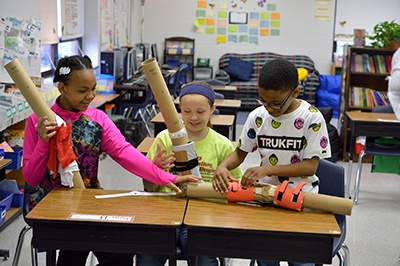
Engineering for Gifted and Talented Populations
We’ve told you about how EiE meets the needs of many student populations, like English Learners and students with diverse needs, but there’s one population benefitting from EiE that may surprise you: students in gifted and talented (GT) programs. This week at the National Association for Gifted Children’s 2016 conference, EiE’s Chris San Antonio-Tunis presented his preliminary research about EiE’s impact on GT populations to a standing-room-only crowd. He shared a few reasons why real teachers from around the country love using EiE in their gifted and talented classrooms.

Out-of-School time | Tuesday, October 25
For Chicago’s Diverse-Needs Students, EiE Works
Back in the 1920s, the Christopher School was built to serve students with disabilities, including many affected by polio. Today, this Chicago public school serves an unusually diverse student population. “Our mission statement is 'Teach All, Reach All, Include All,'" says Mary Meade, the school’s middle-school science coordinator. “Regular education students learn alongside students with severe and profound physical and cognitive disabilities.”
Like every teacher, Mary needs lessons that help every student learn. She also looks for lessons that relate to the real world. That’s how she discovered Engineering Everywhere (EE), EiE’s out-of-school-time curriculum for ages 10–12.