

Engineers apply computer science knowledge to problem solving, and we think children can, too. For more than two decades, we’ve been partnering with PK-12 educators to bring authentic, hands-on engineering challenges into the classroom. Core to these efforts has been helping educators support students as they engage in engineering practices—the habits and behaviors engineers rely on when solving problems. One of the practices that we want educators and students to be aware of is that engineers use computer science knowledge when designing solutions.
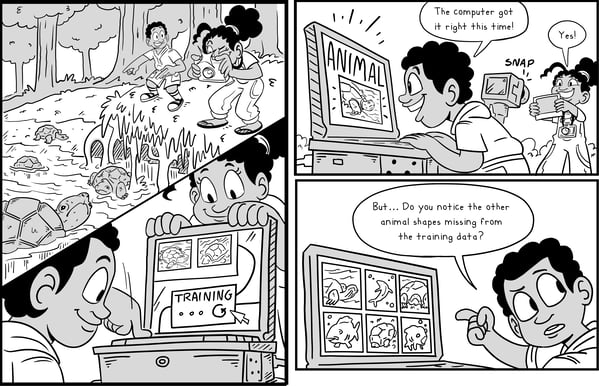
Panel from Is It Trash? comic by YES staff, illustration by Arnold Gutierrez.
“I believe my students gained a better understanding of what computers can and can't do. They were able to see all of the ways that computers can help make people's lives easier, but also just how much human participation needs to go in to making computers work.” – Erin Pender, Science Teacher, Boston, MA
Why Engineers (and Students!) Use Computer Science
One big reason engineers use computer science is efficiency. Computational tools help them work fast and handle complex tasks. Today, many fields are exploring AI for that same reason.
But efficiency isn’t the whole story--accuracy matters, too. And as Erin’s students noticed, computers don’t “think” on their own. They need people to:
• choose what data to use,
• decide what counts as a good result, and
• check whether the computer’s output actually makes sense.
This need for informed, thoughtful human involvement is at the heart of the YES Computer Science Framework—and it’s why we see it as a strong foundation not only for computer science learning, but also for AI literacy.The YES Computer Science Framework Applied to AI
The framework describes why it is important for engineers and students to think computationally: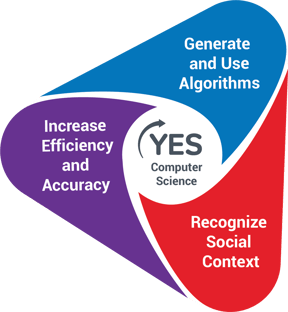
Increase efficiency and accuracy: Engineers use computational tools to solve engineering problems more efficiently and accurately.
Generate and use algorithms: Engineers must understand the algorithms their tools use—and know when to design or refine those algorithms themselves.
Recognize social context: Computational tools are created by people and used by people, which means biases can appear in both the tools and the ways their outputs are interpreted.
Photo Classifications: Building AI Literacy in Elementary School
The YES educator mentioned above was implementing the Photo Classifications computer science module in her 5th grade classroom. This 3-lesson module connects to a storyline first introduced to students in our Engineering Plastic Filters unit: Two child characters notice that waterways in their town are polluted with plastic trash. In class, students use the Engineering Design Process to create, test, and improve a plastic filter that reduces plastic waste entering a bay from a river.
Then, in the corresponding CS module, students shift from engineering a solution for a known, polluted stream to using AI to evaluate whether a different stream could also benefit from a plastic filter. They use a machine learning model to classify objects in photos of the fictional stream as either animals or trash.
What Students Figure Out
As they work, students learn key ideas about machine learning:
 • Machine learning requires training data.
• Computers identify patterns in that data.
• Training data need to be thoughtfully assembled.
• More variety in training data often increases a model's accuracy.
User Reviews Analysis: Continuing AI Literacy in Middle School
Our YES Middle School module, User Reviews Analysis, builds upon these foundational ideas, but shifts to qualitative data (textual user reviews) instead of images. Students are introduced to more complex concepts related to how computers and humans process information.
In this module, students use a machine learning model to analyze fictional reviews written by users of the eco-friendly slippers students engineered earlier.
Using free, web-based interactives from MathWorks, students compare how humans and computers categorize data. They realize that:
 • Humans naturally consider context when reading reviews.
• The machine learning model used in the module only considers word frequency, not meaning or tone.
• A computer may identify patterns that a human considers irrelevant.
While still aiming to improve the accuracy of the machine learning model to categorize the user reviews as positive or negative, the focus expands to the need for large training data sets and more complicated approaches to better approximate human cognition.
They also discuss the real-world stakes: What happens if a machine learning model makes inaccurate predictions? Who is affected?
So… is this the same as ChatGPT?
Not exactly—and that’s okay.
What students do in Photo Classifications and User Reviews Analysis is called supervised machine learning. They train a model using labeled examples and then see how well it can classify new data.
ChatGPT and other generative AI tools work differently. But supervised machine learning is a perfect starting point, because it helps students understand the big ideas behind AI:
• AI learns from data.
• AI finds patterns.
• AI reflects human choices (and sometimes human biases).
• AI needs humans to guide, question, and improve it.
We’re all figuring out how to prepare students for the growing presence of AI in their lives. These modules give students a grounded, meaningful way to begin.
Looking ahead
If you’re teaching during CS Education Week, this year’s theme—“CS Powers AI Innovation”—fits beautifully with these lessons. (And yes, we’d love to see you at the Museum of Science CS Education Weekend, Dec 13-14!)
More importantly, though, this work belongs in classrooms all year long—because AI literacy isn’t a “future topic.” It’s a now topic.
For a previous blog post on the YES Computer Science Framework, see https://yesblog.mos.org/engineering-critical-thinkers-integrating-computer-science-and-engineering


