

Go to the YES Blog homepage

EiE Research Results | Tuesday, July 7

Studying How Teachers Respond to Failure in the Engineering Classroom

The word “theory” has a precise meaning for scientists . . .  and often a different meaning for politicians (“An evidence-based explanation of a phenomenon” versus “Oh, it’s just a hunch”). In much the same way, the word “failure” seems to have one meaning in the engineering workplace and another in school (“Failure is normal, it helps you learn” versus “You got a failing grade”).

“As we bring engineering into elementary classrooms, we are bringing in a new way of thinking and speaking about failure,” says Dr. Pam Lottero-Perdue, an associate professor of science education at Towson University with a background in engineering. “Teachers will need to understand BOTH ways of thinking about failure—to become guides who help students navigate that border crossing.”

Scholarships and Awards | Tuesday, June 30

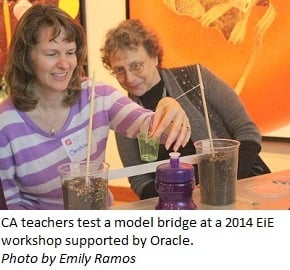
Oracle Grant Brings Classroom Engineering to MA Elementary Teachers

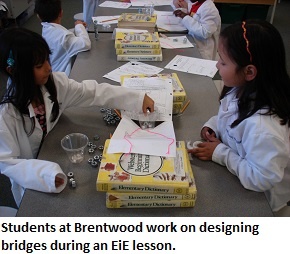
Recent changes in Massachusetts academic standards mean that teachers in the state will be integrating more engineering content and practices with the science lessons they teach.This new expectation for STEM instruction can be uncomfortable for elementary teachers, who don’t usually take engineering coursework as part of their teacher preparation.

A recent grant to the Museum of Science, Boston by the information technology company Oracle will help 20 Massachusetts educators boost their classroom engineering skills as they learn to use the award-winning Engineering is Elementary curriculum, developed at the Museum's National Center for Technological Literacy®

Out-of-School time | Thursday, June 25

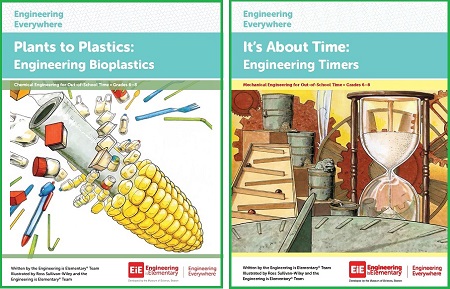
New Afterschool and Camp Activities for Middle School from EiE

Just in time for summer camp, EiE’s Engineering Everywhere curriculum has two new hands-on curriculum units designed for middle school-aged engineers:

  • It’s About Time” poses a mechanical engineering challenge: Design your own timekeeping device
  • Plants to Plastics” is a chemical engineering challenge: Make plastic from ecofriendly plant-based materials 

Profiles | Monday, May 22

Engineering a School Turnaround

The June 2015 online issue of Educational Leadership explores the theme “Improving Schools from Within.” The magazine invited educators to share stories of schools that changed for the better—and how they did it. 

Emily Hardee, a North Carolina STEM coordinator, tells the story of a Raleigh elementary school that transformed itself from one of the lowest performing schools in the district into a STEM school that’s a model for the state. We’re gratified to know that the Engineering is Elementary curriculum played a part in the change.

Early Childhood STEM Education | Tuesday, June 16

Charting a Course to Early Childhood STEM

When the Engineering is Elementary curriculum was first being developed, one skeptic told EiE director Christine Cunningham, “You’re crazy. It’s impossible to teach engineering to elementary students!” Today, the Next Generation Science Standards (NGSS) have made K - 5 engineering mainstream. Meanwhile, the Obama administration is thinking about even younger engineers.

The President has made early childhood education a priority, including—at the urging of the National Science Boardearly STEM education. But what does “quality Pre-K - K STEM education” look like? And how do you help teachers expand early STEM education nationwide? EiE’s director, Christine Cunningham, is one of 14 educators pondering such questions as part of the Early Childhood STEM Working Group, meeting this week in Chicago. 

All posts

Current page: 104

Subscribe to Email Updates

Posts by Topic

see all